
 Martín Véliz

Let’s be honest, we’ve all been there. You’re stuck on the content treadmill, pushing out post after post, video after video, with barely a ripple to show for it. It’s exhausting, and it makes you wonder if all this effort is even worth it. If that sounds familiar, the problem isn’t your work ethic—it’s the absence of a real strategy.
This guide is your off-ramp from that content hamster wheel. We’re going to move beyond just making stuff and start building a smart, repeatable system that turns your effort into a predictable growth engine. You’ll learn how to develop a content strategy that solves your biggest problems: running out of ideas, wasting time on content that doesn’t perform, and feeling completely burned out.
Stop Creating Content and Start Building a Strategy

The alternative to a good strategy is painful and expensive. You pour hours, sometimes days, into what feels like a masterpiece—a blog post, a video, a podcast episode—only to be met with crickets. A few pity likes, maybe a comment from your mom, but zero real engagement. That cycle is what leads to burnout, and it’s a problem we’re here to solve.
The Shift to Strategic Content
Here’s the thing: the game has changed. Success isn’t about who can shout the loudest or publish the most. It’s about who has the best map. The content marketing industry is exploding, projected to hit $1.95 trillion by 2032. And it’s no surprise that 84% of businesses are now operating with a documented strategy. The proof is in the data—having a plan isn’t optional anymore; it’s the cost of entry. You can dive deeper into these growth stats here.
A solid strategy gives your work purpose and direction. It helps you:
- Define Your Win: Know exactly what you’re trying to achieve before you even think about topics.
- Be a Mind Reader: Create content that lands perfectly because it speaks directly to your ideal customer’s biggest problems.
- Build a Machine: Stop guessing and start building a repeatable system that produces high-impact content consistently.
A content strategy is the difference between throwing spaghetti at the wall to see what sticks and using a detailed recipe to cook a perfect meal every single time. It brings intention and predictability to your marketing.
So, how do we build this system? It starts with four key pillars that anchor your entire plan. This table breaks down what they are and why they matter.
The Four Pillars of an Effective Content Strategy
| Pillar | What It Solves | Key Action |
|---|---|---|
| Goals & KPIs | ”Is any of this actually working?” | Set clear, measurable business objectives (e.g., leads, sign-ups) instead of just vanity metrics. |
| Audience & Channels | ”Who am I talking to and where are they?” | Develop detailed customer personas and identify the platforms where they actually spend their time. |
| Content Pillars & Audit | ”What should I even be talking about?” | Identify 3-5 core themes your brand owns and analyze your existing content for gaps and opportunities. |
| System & Workflow | ”How can I do this without burning out?” | Create a repeatable process for creation, repurposing, and distribution—with a heavy emphasis on automation. |
Getting these four pillars right is the foundation for everything that follows. It’s how you turn random acts of content into a cohesive, goal-driven machine.
How a Smart System Changes Everything
Throughout this guide, we’ll walk through setting those business-focused goals, getting inside your audience’s head, and mapping out a plan that truly connects. But more importantly, we’ll look at how smart tools can completely transform your workflow.
One of the biggest hurdles is turning that high-level plan into consistent, quality content without hiring a massive team. This is where a platform like EchoWriteAI becomes your unfair advantage. It solves the core problem of the “content grind” by helping you automate the nuts and bolts of creation and distribution. It lets you spin a single core idea into a full-blown, multi-channel campaign without the manual effort that leads to burnout.
This is especially critical when you’re aiming to build a thought leadership content strategy, which demands a steady stream of expert-level content. By bringing smart automation into your process, you can finally execute your brilliant plan at scale and get the results you’ve been working so hard for.
Set Goals That Actually Drive Business Growth
Let’s be honest: content without a goal is just noise. It’s the reason so many solopreneurs and small businesses feel like they’re just spinning their wheels, publishing post after post with nothing tangible to show for it. This feeling of wasted effort is one of the biggest problems a good strategy solves.
If your strategy starts and ends with “we need more traffic,” it’s time for a hard reset. Real growth happens when you stop chasing vanity metrics and start connecting your content directly to your bottom line.
So, let’s get past the vague wishes and define what success actually looks like for your business. This means setting crystal-clear, measurable objectives that tell you, without a doubt, if your efforts are paying off.
Defining Your “North Star” Metric
Your content goals should be a direct reflection of your business goals. Simple as that. Are you trying to book more consulting calls? Grow your paid newsletter? Generate qualified leads for a new product? Each of these demands a completely different content playbook.
Start by zeroing in on one primary objective—your North Star Metric. This is the single number that best captures the core value you deliver to your customers.
Here’s what this looks like in the real world:
- For a SaaS Company: The goal might be to increase free trial sign-ups by 20% in the next quarter. Every blog post, every video, every social update should be engineered to solve a problem that the software fixes, guiding people straight to that trial page.
- For a Creator/Solopreneur: The objective could be to grow an email list by 500 subscribers a month. In this case, every piece of content becomes a vehicle for a strong call-to-action, pushing a valuable lead magnet or a direct subscription.
- For a Small Local Business: The focus might be on boosting appointment bookings by 15%. The content would then be laser-focused on local SEO keywords, customer success stories, and case studies that resonate with the community.
Once you’ve locked in your primary goal, you can then build out secondary goals that support it, like hitting certain search engine rankings or boosting social media engagement.
Turning Vague Goals into Hard Numbers (KPIs)
A goal without a number is just a dream. To make your objectives real, you have to attach Key Performance Indicators (KPIs) to them. Think of KPIs as the cold, hard data that proves your content is doing its job. They give you a brutally honest picture of what’s working and what’s not.
Vague goals lead to vague results. Specific, measurable KPIs are the only way to know if your content strategy is a valuable asset or just an expensive hobby.
This is where so many creators get stuck. The sheer volume of data available is overwhelming. The trick is to ignore the noise and select only the metrics that directly impact your North Star.
Matching KPIs to Your Business Goals
| Business Goal | Primary KPI | Secondary KPIs |
|---|---|---|
| Lead Generation | Number of qualified leads from content | Form conversion rate, Cost per lead, Email sign-ups |
| Brand Awareness | Branded search volume | Social media reach, Mentions, Share of voice |
| Sales Growth | Revenue attributed to content | Conversion rate on product pages, Customer lifetime value |
Of course, the constant challenge is finding the time to create content that actually moves these numbers. It’s not just about writing; it’s the research, the optimization, and making sure every single piece aligns with your KPIs. For small teams and solopreneurs already stretched thin, this is a massive pain point.
This is where a tool like EchoWriteAI completely changes the game. It solves this problem by letting you focus on the high-level strategy—the goals, the KPIs, the big picture—while automating the most time-sucking parts of content creation. By generating optimized drafts that are already aligned with your objectives, it frees you up to analyze performance and make smart decisions, rather than getting buried in the daily grind of writing.
To see how this all connects to making money, you can dive deeper into our guide on how to monetize content. This approach ensures your output is always working for you, making your entire content operation more efficient and, ultimately, more profitable.
Get to Know Your Audience (And Their Journey)
If you’re creating content for “everyone,” you’re really creating it for no one. I’ve seen this mistake derail countless promising creators and businesses. The most potent content strategies are built on a deep, almost obsessive understanding of who you’re talking to. We have to go beyond surface-level stats and get inside their heads to solve their problems effectively.
Your mission is to paint a crystal-clear picture of your ideal customer. What’s their biggest frustration right now? What questions are they secretly typing into Google in the middle of the night? What’s the one outcome they’re desperately trying to achieve? Answering these questions is the bedrock of a strategy that actually works.
Go Way Beyond Basic Demographics
The chasm between a generic and a powerful audience persona is depth.
A generic persona is lazy: “Our audience is marketers aged 30-45.”
A powerful persona is a story: “Our ideal customer is ‘Sarah,’ a 38-year-old solo consultant. She’s brilliant at her craft but completely overwhelmed by the pressure to be ‘on’ all the time on social media.”
See the difference? Sarah has real problems you can solve. She feels the constant pressure to post but struggles to find the time between client work and just running her business. That’s a pain point you can build an entire content strategy around.
To build a persona as real as Sarah, you have to do the work and dig for insights:
- Talk to Your People: Seriously, just talk to your best customers. Ask them what their day-to-day looks like, what tools they can’t live without, and what keeps them up at night. You’ll be amazed at what you learn.
- Survey Your Audience: Use simple tools to ask direct questions about their goals and biggest roadblocks.
- Be a Fly on the Wall: Monitor conversations in places like Reddit or LinkedIn groups where your audience hangs out. What language do they use? What questions pop up over and over again?
This research isn’t a one-and-done task; it’s a living, breathing part of your strategy. The more you listen, the sharper your content will become, and the more it will connect with the right people.
Map the Customer Journey
Once you know who you’re talking to, you need to map out their journey—the path they take from realizing they have a problem to becoming your biggest fan. Each stage of this journey demands a different kind of conversation and a different type of content.
Think of it like this: you wouldn’t propose on a first date, right? In the same way, you can’t shove a product demo in front of someone who is just starting to figure out what their problem even is.
A customer journey map reveals exactly what your audience needs to hear at each stage. It turns your content from a random series of posts into a guided path that builds trust and solves problems every step of the way.
Let’s break down the three core stages and the kind of content that fits each one like a glove:
-
Awareness Stage (The “Problem” Stage): Here, your audience feels a pain point but might not know how to name it or that solutions even exist. Your job is to educate and inform, not sell.
- Content That Works: “How-to” blog posts, checklists, quick educational videos, shareable infographics.
- Your Goal: To become a trusted resource and simply get on their radar.
-
Consideration Stage (The “Solution” Stage): They’ve put a name to their problem and are now actively researching different ways to solve it. Now you can get a bit more specific about how your approach is the answer.
- Content That Works: In-depth guides, compelling case studies, product comparisons, expert webinars.
- Your Goal: To position your method as the best possible solution for their specific problem.
-
Decision Stage (The “Purchase” Stage): They’re ready to make a choice. The content here needs to knock down any final barriers and make them feel incredibly confident about choosing you.
- Content That Works: Free trials, live demos, glowing customer testimonials, clear pricing pages.
- Your Goal: To convert them from a prospect into a happy customer.
This is where the classic “what do I even post?” paralysis kicks in. Manually creating unique, high-quality content for each of these stages, across multiple channels, is a monumental time-suck for any solopreneur or small business.
This is precisely the problem we built EchoWriteAI to solve. Instead of you having to guess what to create, the platform can help you generate on-point content ideas and drafts tailored to these specific journey stages. You can focus on the high-level strategy and mapping, while EchoWriteAI handles the heavy lifting of populating your calendar with the right message for the right person at the perfect time.
As you craft your content, it’s also important to consider how it all fits into a broader plan. You can learn more about this in our guide to creating a cohesive small business social media strategy.
Build Your Content Production Engine
If you feel like you’re stuck on a content treadmill, you’re not alone. The constant pressure to brainstorm, create, and publish is exhausting. But what if you could ditch the chaos for a system? A repeatable process that turns your big-picture strategy into a steady, predictable flow of high-impact content. That’s what a true production engine is all about, and it’s the solution to your content creation burnout.
The secret isn’t creating more content; it’s creating smarter. And the best way to do that is with the content pillar model. Instead of chasing every new trend or shiny object, you’ll plant your flag on three to five core topics that you can absolutely own. These are the sweet spots where your expertise smashes right into your audience’s biggest problems.
Think of them like the main trunks of a giant redwood. Every blog post, video, tweet, and newsletter you create is just a branch growing from those massive, sturdy trunks. This simple shift stops the frantic “what should I post today?” panic in its tracks and gives you a clear roadmap for months, or even years, to come.
Uncovering Your Core Content Pillars
So, how do you find these magical pillars? It’s less of a guessing game and more of a strategic deep dive. You need to look inward at your strengths and outward at the market you serve. For example, a solopreneur who’s a wizard with spreadsheet automation might build their entire strategy around pillars like “Productivity Systems,” “No-Code Tooling,” and “Small Business Scalability.”
To find yours, grab a notebook and start asking the hard questions:
- What problems are we uniquely qualified to solve? This isn’t just about what you sell. It’s about the hard-won expertise you bring to the table.
- What topics do our customers and followers always ask about? Dive into your DMs, email replies, and support tickets. The patterns are there.
- Where do we want to be the undisputed authority in our niche? Your pillars should be a direct reflection of your long-term ambitions.
The answers will point you to the foundational topics that become the heart of your content. This is how you stop being just another voice and start building real authority.
Audit Your Past Work to Fuel Your Future
Before you create a single new thing, it’s time to go treasure hunting in your own archives. A content audit is your map to uncovering hidden gems and glaring gaps in your existing library. You’d be surprised how often a two-year-old blog post is just a few tweaks away from being a cornerstone piece for a brand-new pillar.
Don’t let your old content gather digital dust. An audit is the fastest way to get more mileage out of the work you’ve already done. It shows you what to refresh, what to repurpose, and what to create next.
This doesn’t have to be some monstrous task. A simple spreadsheet will do. Log your best-performing content, noting the format, topic, and key metrics. This data tells you exactly what your audience loves, taking all the guesswork out of your next move.
The infographic below breaks down how different content types fit into your customer’s journey, from their first “hello” to becoming a loyal fan.
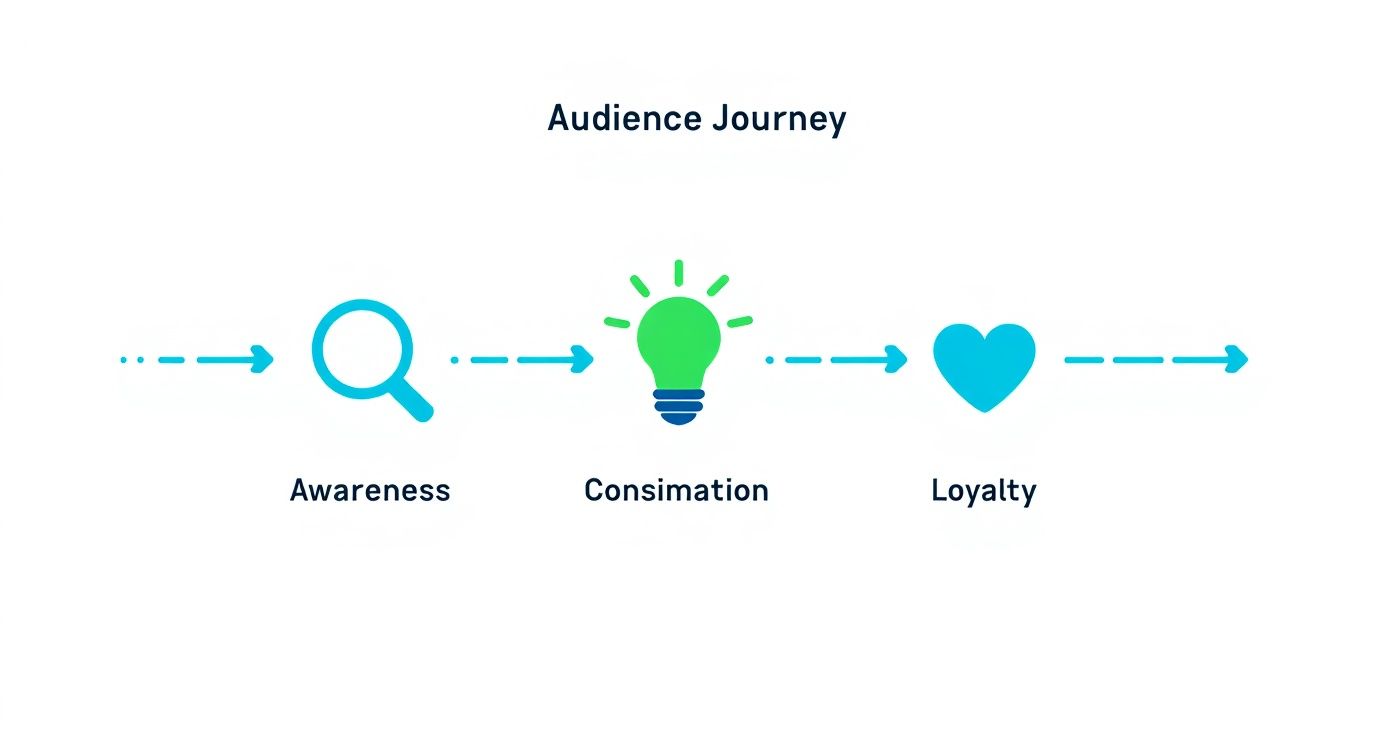
As you can see, your pillars need to feed every stage of this journey to keep people moving forward with you.
Building a Repeatable Workflow
This is where the rubber meets the road—and where most creators burn out. The manual grind of slicing and dicing one big idea into a dozen different assets is a killer. It’s also precisely the kind of problem AI was born to solve.
Smart budgeting isn’t just for big corporations anymore. While 46% of B2B marketers expect their budgets to grow in 2025, small businesses are finding a different way to win. In fact, 51% of small businesses report spending nothing extra on content marketing because they’re using AI to do the heavy lifting. Find out more about the latest content marketing financial trends to see how the game is changing.
Imagine one of your content pillars is “Email Marketing Automation.” You pour your heart into writing one definitive, in-depth guide on the topic. Great. But don’t stop there.
With a tool like EchoWriteAI, that single guide instantly becomes the seed for an entire content ecosystem. It directly solves the problem of content repurposing by generating:
- A 10-part email mini-course to capture leads.
- A week’s worth of insightful LinkedIn posts with key takeaways.
- A punchy script for a short YouTube video.
- A dozen engaging tweets to drive traffic back to the original article.
Suddenly, you’ve turned one focused effort into weeks of high-value content, all perfectly tied to your core pillar. This is how you build a production engine that actually scales without leading to burnout. Think of AI as your content multiplier, handling the grunt work so you can stay focused on the brilliant ideas. Integrating the right social media content creation tools like this into your workflow creates a system that just works.
Turn One Piece of Content Into a Dozen Assets
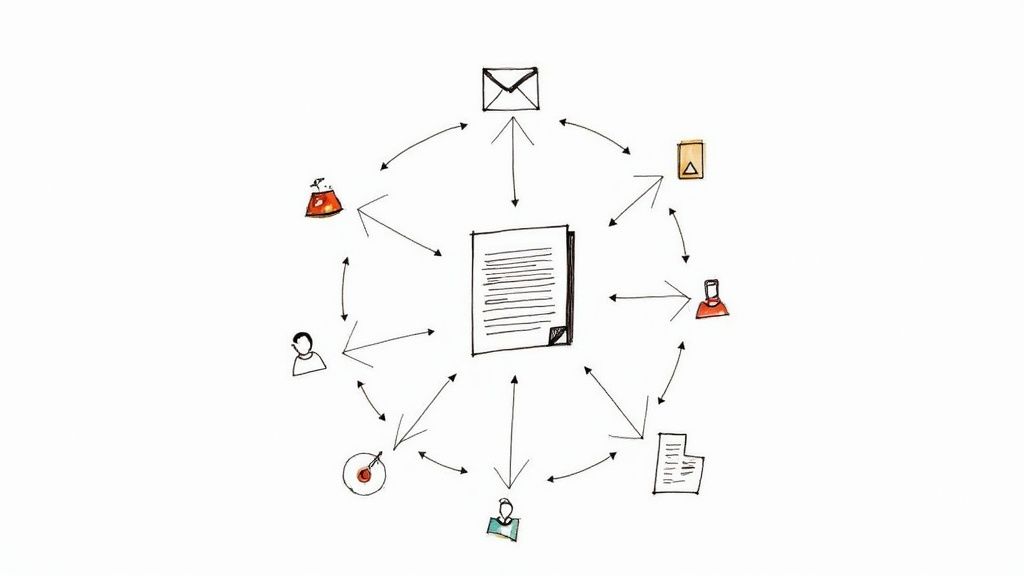
Hitting “publish” feels like the finish line, but in reality, it’s the starting gun. If your strategy stops the moment your content goes live, you’re leaving 80% of your potential impact on the table.
The old “publish and pray” model is a recipe for frustration. You pour your heart into creating something amazing, only to watch it get a brief moment of attention before vanishing into the digital ether. It’s a waste of great work, and it’s a problem we can fix.
The secret to getting the highest possible ROI on every word you write is to adopt a “create once, distribute forever” mindset. It’s how you turn a single, long-form article into a whole ecosystem of assets, each perfectly suited for a different channel and audience segment. This is how you stay top-of-mind without being chained to the content creation hamster wheel.
This isn’t just about spamming the same link everywhere. It’s about strategically deconstructing your core ideas and then reconstructing them into new, native formats that give them a fresh life.
The Art of the Content Remix
Let’s get practical. Say you just published a killer 2,000-word guide on building a personal brand. Instead of just tweeting out the link and calling it a day, you can slice and dice that one asset into a full week’s worth of high-value content.
Not only does this save you a ton of time, but it also meets your audience where they are, in the formats they actually want to consume.
Here’s how that one guide can fuel your entire content calendar:
- LinkedIn Post: Pull the three most actionable takeaways and frame them as a sharp, bulleted list. Add a compelling hook to grab the attention of busy professionals scrolling their feed.
- Instagram Reel/TikTok: Turn the core concepts into a quick 60-second video script. Add some dynamic text on screen, pair it with trending audio, and you’ve got a shot at viral visibility.
- Email Mini-Course: Break the guide down into a 3-part email series for your subscribers. This delivers immense value straight to their inbox and nurtures your most important audience.
- Shareable Infographic: Visualize the key statistics or framework from your article. This is perfect for Pinterest or as a visual slide deck to share on LinkedIn.
This systematic repurposing dramatically extends the lifespan and reach of everything you create. But let’s be honest—doing all of this by hand is a soul-crushing time sink.
Your biggest challenge isn’t a lack of ideas; it’s the lack of time to execute them all. Smart distribution isn’t about working harder; it’s about making your core content work harder for you.
To help you visualize this, here are a few common ways to remix your core content pillars.
Content Repurposing Cheatsheet
This table breaks down how you can transform one central piece of content into multiple assets, tailored for different platforms to maximize engagement.
| Original Content | Repurposed Asset 1 | Repurposed Asset 2 | Repurposed Asset 3 |
|---|---|---|---|
| Long-Form Blog Post | Twitter Thread (Key takeaways) | YouTube Video (Deeper dive into one section) | Infographic (Visualizing data/stats) |
| Podcast Episode | Audiograms (Short, shareable clips for social) | Blog Post (Expanded show notes with a full transcript) | LinkedIn Carousel (Highlighting key quotes) |
| Webinar/Live Video | Short Video Clips (Best moments for Reels/TikTok) | Email Series (Breaking down the content for subscribers) | SlideShare Presentation (Uploading the slide deck) |
| Case Study | LinkedIn Post (Focusing on the challenge and solution) | Tweet Series (Sharing the most impressive results) | One-Page PDF (Gated content for lead gen) |
As you can see, the possibilities are endless. The main obstacle isn’t inspiration—it’s the sheer manual labor involved. This is where you need a better system.
Build an Automated Distribution Engine
Imagine a workflow that automatically takes your latest blog post or video and generates platform-native social updates, email snippets, and more—all in your unique voice. This is the power you unlock when you build AI into your distribution process.
This is exactly what a tool like EchoWriteAI was built to do. It solves the distribution headache by plugging directly into your content sources, like a blog’s RSS feed or a YouTube channel, and instantly turning each new piece into a ready-to-launch multi-channel campaign.
Instead of spending hours rewriting, reformatting, and scheduling, you can set up a campaign that automatically:
- Pulls the most powerful quotes from an article for a series of tweets.
- Summarizes your key arguments into a thoughtful LinkedIn post.
- Generates engaging questions based on your content to spark conversation.
This is how you get off the tactical hamster wheel. It frees you up to focus on creating your next great pillar piece, knowing your distribution is running on autopilot. This is how you build a content strategy that scales your reach, not your workload.
Your Top Content Strategy Questions, Answered
Alright, let’s tackle some of the questions that always come up when you start getting serious about your content. It’s one thing to talk about strategy, but it’s another to live and breathe it every day. These are the real-world sticking points I see creators and small businesses wrestle with all the time.
How Often Should I Actually Update My Content Strategy?
This is a great question because it gets at a common misconception. Your content strategy isn’t a “set it and forget it” kind of thing. Think of it more like a living document.
I recommend a full, top-to-bottom review at least quarterly. This is your chance to zoom out and ask the big questions: Are our business goals the same? Have we learned anything new about our audience? Are our core content pillars still hitting the mark?
But that’s the big picture. On a more frequent basis—say, monthly—you need to be looking at the tactical side of things. Check in on your KPIs. Is that video series actually driving traffic? Is our engagement on LinkedIn suddenly taking off? This constant pulse-check lets you pivot quickly. You can double down on what’s working or cut what isn’t without waiting three months for a formal review.
The quarterly review is for steering the ship. The monthly check-in is for trimming the sails.
What’s the Real Difference Between a Content Strategy and an Editorial Calendar?
People mix these up all the time, but getting this right is the key to staying sane and organized. It’s simple, really.
-
Your Content Strategy is the Why. It’s your game plan. It’s the high-level thinking that defines who you’re talking to, what you’re helping them with, why it matters to your business, and what core themes (your pillars) you’ll own. It’s the North Star for everything you create.
-
Your Editorial Calendar is the What, When, and Where. This is where the rubber meets the road. It’s the practical, boots-on-the-ground schedule of specific blog posts, video scripts, tweets, and newsletters for specific dates and channels.
Think of it this way: Your strategy is the blueprint for the house, but your editorial calendar is the construction schedule that tells you when the foundation gets poured and the walls go up.
You can’t have one without the other. A great strategy makes sure your calendar is filled with purposeful content, not just random acts of creation.
Can I Really Build a Strategy if I’m on a Shoestring Budget?
Not only can you, but you have to. A tight budget makes a sharp strategy your single most important asset. When you can’t afford to waste a single second or a single dollar, a clear plan is what separates focused growth from frantic burnout.
A good strategy forces you to be ruthless. Instead of trying to be everywhere, you’ll pinpoint the one or two channels where your audience truly lives. Instead of churning out endless one-off pieces, you’ll focus on creating amazing pillar content that you can slice, dice, and repurpose for weeks.
This is where smart automation becomes a true force multiplier. For a solopreneur, the bottleneck isn’t a lack of ideas—it’s the crushing lack of time. An AI-powered tool like EchoWriteAI is the perfect solution. It can take one great idea and help you research, draft, and spin it into a dozen different formats. It allows a one-person show to have the output of a small team, minus the payroll.
How Do I Actually Measure the ROI of All This Content?
Measuring the return on your content investment all comes back to the goals you set in the very beginning. If you can’t draw a straight line from a blog post to a business result, you’re just chasing vanity metrics like views and likes.
The trick is to connect your content metrics (traffic, engagement) to your business metrics (leads, sales).
Here’s a practical way to look at it:
-
Goal: Lead Generation? Your key metric is qualified leads from content. You need to be tracking how many people filled out a form, downloaded a guide, or signed up for your newsletter after engaging with a specific piece of content. Use UTM parameters in your links to make this crystal clear in your analytics.
-
Goal: Brand Awareness? You’re looking for signs that your brand’s footprint is expanding. Monitor things like “branded search” (how many people are Googling you by name), direct traffic to your site, and your share of voice or mentions on social media.
-
Goal: Driving Sales? This is about attribution. Your analytics can help you see which articles or videos people consumed on their path to making a purchase. You’ll start to see which content is just for browsing and which content actually helps close the deal.
When you connect the dots this way, you’re no longer guessing. You can confidently show exactly how your content strategy is fueling the bottom line.
Feeling the pressure to create and distribute all this content consistently? That’s precisely why we built EchoWriteAI. It’s designed to be your AI partner, solving your biggest content problems by turning a single idea into weeks of strategic social media posts, all in your voice. Stop the manual grind. Start building a content engine that works for you. Transform your content workflow with EchoWriteAI today.