
 Martín Véliz
Are you pouring hours into creating content, only to hear crickets? It’s a frustrating, all-too-common problem for small business owners. You’re stuck on a hamster wheel, posting just to post, with no real business growth to show for it. This guide is your way out. We’ll show you how to build a small business content strategy that stops the random acts of content and starts generating real results, even when you’re short on time and resources.
Escaping the Content Creation Hamster Wheel
Does this feel a little too real? You pour hours into brainstorming, writing, and designing a new piece of content. You hit “publish,” hold your breath, and then… nothing. So the next day, you’re right back at it, stuck in a never-ending cycle that feels more like a chore than a growth plan.
Welcome to the content creation hamster wheel. It’s a frustrating place that countless small business owners know well.
You’re not just imagining it. This cycle of throwing random, disconnected content at the wall leads straight to burnout and completely wasted resources. It’s that daily dread of staring at a blank screen, wondering, “What on earth should I post today?” while the sting of yesterday’s post getting zero results is still fresh.
Why Your Random Acts of Content Are Failing
When you don’t have a real plan, your content efforts are scattered and, frankly, pretty useless. The problem isn’t that you’re not trying hard enough; it’s that you’re operating without a map. This leads to painful problems that drain your time and energy.
Your content is likely struggling with:
- Inconsistent Messaging: One day you’re posting about a product feature, the next it’s a motivational quote. This randomness confuses your audience and makes it impossible to build a memorable brand.
- Failure to Connect: Are you creating content about what you want to say, or what your audience is desperate to hear? If your content doesn’t solve a real problem for them, it will always fall flat.
- Wasted Time and Energy: Every hour you spend creating content that doesn’t push you toward a business goal is an hour you’ll never get back. For a small business owner, that’s a massive, unsustainable drain.
Here’s a number that should make you sit up and pay attention: having a documented content strategy makes you 833% more likely to report success than those who don’t. It’s the single biggest change you can make to turn random effort into a reliable growth engine.
The Strategic Shift from Creator to Business Builder
The only way off that hamster wheel is to build and commit to a structured small business content strategy. This is your escape route from the chaos. It’s all about a mindset shift—stop thinking like a frantic content creator and start acting like a strategic business builder.
This doesn’t mean you have to create more content. In fact, you’ll probably end up creating less, but you’ll make sure every single piece packs a much bigger punch. For example, instead of churning out a dozen one-off social posts, a smart strategy would be to create one powerful, in-depth blog post and then repurpose it into a whole collection of smaller assets. We break down exactly how to do this in our guide to AI content repurposing.
This is where you stop doing all the heavy lifting yourself. A smart strategy relies on smart tools. EchoWriteAI was built to solve this exact problem for small businesses. It automates the tedious work of creating and distributing high-quality content from your core ideas, freeing you from the daily grind so you can focus on what really matters: growing your business.
Defining Your Content’s Purpose and Audience
Before you write a single word, you have to answer two fundamental questions: Why are we doing this, and who are we doing it for? Without this foundation, you’re just adding to the noise. This is where you connect your content directly to real-world business results, ensuring every bit of effort moves your small business forward.
The biggest mistake is chasing vanity metrics. Likes and shares are nice, but they don’t pay the bills. The real problem is when your content isn’t generating qualified leads, closing more sales, or building a loyal customer base. Every piece of content needs a job.
Start with Business Goals, Not Content Ideas
I know it’s tempting to dive right into brainstorming blog topics or viral video ideas. But hold that thought. Your content strategy has to be a direct extension of your business objectives. What are you actually trying to accomplish this quarter?
The trick is to draw a straight line from your big-picture goals to the content you create.
- Problem: Sales are flat. Your content should focus on helping people make a buying decision. Create detailed case studies, product comparison guides, or a webinar that shows your solution in action.
- Problem: Your lead pipeline is empty. Create high-value lead magnets. Solve a specific problem for your ideal customer with a checklist, template, or e-book, all promoted through SEO-optimized blog posts.
- Problem: Nobody sees you as an expert. You need to consistently publish insightful, data-backed articles, host expert interviews, or write sharp opinion pieces that offer a fresh take on industry trends.
The best content isn’t just out there—it’s doing a specific job. When you tie every article, video, and post back to a core business objective, your content marketing stops being an expense and becomes a measurable investment.
This alignment is everything. If you’re having trouble turning broad goals into a concrete plan, having a solid framework is a game-changer. We break down some practical methods for this in our complete guide on how to develop a content strategy.
To make this even clearer, let’s look at how these pieces fit together.
Connecting Content Goals to Business Results
See how specific content goals translate directly into tangible success metrics for your small business.
| Business Objective | Content Goal | Key Performance Indicator (KPI) |
|---|---|---|
| Increase Brand Awareness | Drive traffic to the website and grow social media following. | Website traffic, social media reach & engagement, brand mentions. |
| Generate New Leads | Capture contact information from interested prospects. | Lead magnet downloads, form submissions, webinar registrations. |
| Boost Sales Revenue | Nurture leads and drive conversions at the bottom of the funnel. | Demo requests, trial sign-ups, sales conversion rate, cart value. |
| Improve Customer Loyalty | Provide value to existing customers to encourage repeat business. | Customer retention rate, email open/click rates, repeat purchase rate. |
Mapping it out like this ensures your content efforts are always pointed in the right direction.
Create a Customer Avatar So Real You Could Talk to Them
Once you know why you’re creating content, you have to get laser-focused on who you’re creating it for. Generic content gets ignored. The problem is, if you’re talking to everyone, you’re talking to no one. To fix this, you need a detailed customer avatar—a living, breathing portrait of your ideal customer.
The whole point is to understand their world so intimately that your content feels like it was written just for them.
Go deeper than just age and location. What are their biggest headaches at work? What keeps them up at night? What are their career goals, and what’s standing in their way? Knowing the answers is how you create content that truly connects.
For instance, a business consultant’s avatar might be “Startup Sarah.” She’s 32, a founder who’s completely overwhelmed by marketing and desperately needs a clear, actionable plan to grow without burning out. With Sarah in mind, you can write a post titled “The Overwhelmed Founder’s Guide to Marketing on a Shoestring Budget” instead of something generic like “Marketing Tips for Businesses.” See the difference?
This is where EchoWriteAI solves a huge problem. You’re not just guessing what your audience wants anymore. Once you’ve defined “Startup Sarah,” you can tell EchoWriteAI about her challenges, and it will instantly brainstorm content ideas, generate outlines that hit on all her pain points, and even draft social media posts in her language. It eliminates the guesswork, letting you focus on the strategic insights that only you can provide.
Creating High-Impact Content Without the Burnout
Let’s be honest. For most small business owners, the biggest problem isn’t a lack of brilliant ideas—it’s the clock. You’re constantly juggling operations, sales, and customer service, leaving almost no time for content. This pressure to “just get something out there” leads to burnout, rushed work, and content that just doesn’t connect.
But what if you could multiply your output without multiplying your effort? The answer isn’t about working harder. It’s about working smarter by building efficient systems and using the right tools to handle the heavy lifting. This is how you solve the time crunch and create a steady stream of high-quality content.
Building a Smart Content Creation Workflow
A repeatable workflow is your secret weapon against chaos. It transforms the stressful act of content creation into a calm, predictable process. Instead of facing the monumental task of “creating content,” you’re just tackling small, manageable steps. You’ll never have to stare at a blank page again.
Your workflow should map the entire journey, from a spark of an idea to a polished, published piece.
- Brainstorming and Ideation: Don’t wait for inspiration to strike. Schedule time to generate ideas by focusing on your customer’s biggest problems. What are they Googling at 2 AM? What daily frustrations can you help them solve?
- Outlining for Clarity: Before you write a single word, create a detailed outline. A solid outline can easily cut your writing time in half and ensures your content is logical, comprehensive, and stays on point.
- Drafting and Production: With your outline in hand, drafting is just about filling in the blanks. Forget perfection on the first pass; the goal is simply to get your ideas down.
- Review and Polish: Now’s the time to refine your draft. Check for clarity, punch up the language, and inject your brand’s unique voice and personality.
A structured workflow is your best defense against content creation burnout. It provides a clear path forward, eliminating the guesswork and anxiety that comes from starting from scratch every single time. Your content becomes a repeatable, scalable asset, not a daily chore.
This isn’t just for blog posts. This exact same process works for video scripts, podcast episodes, and social media campaigns. The core principles—plan, outline, execute—give you a solid foundation for everything you create.
The infographic below shows how this all ties back to your core business strategy. Great content isn’t created in a vacuum; it flows directly from your goals and your deep understanding of your customer.
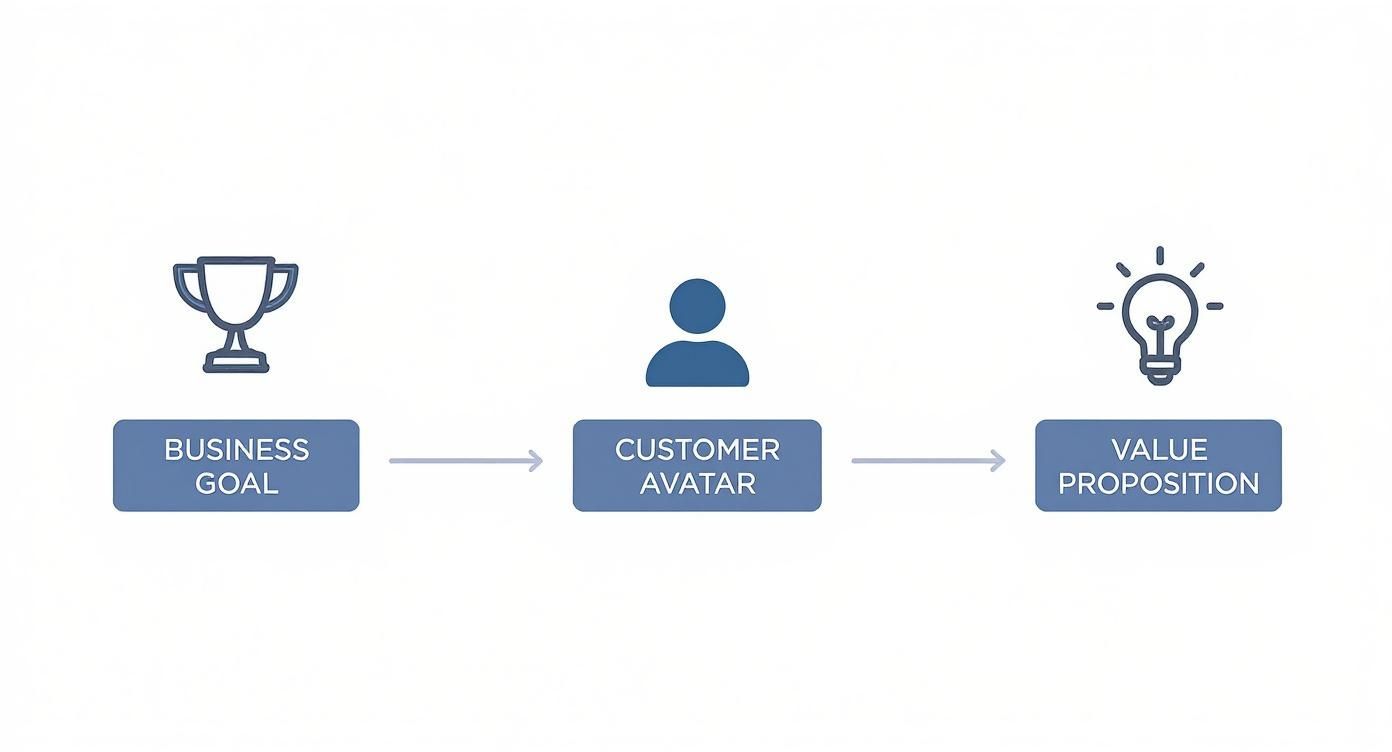
This just reinforces that powerful content starts long before you start writing. It’s rooted firmly in your business objectives and who you’re trying to help.
Let AI Be Your Content Creation Co-Pilot
Here’s the reality for a time-strapped entrepreneur: you can’t do it all yourself. This is where artificial intelligence solves your biggest problem—the lack of time. AI takes over the most repetitive and time-consuming parts of your content workflow.
This isn’t just some future trend; it’s happening right now. A recent study found that 67% of small business owners and marketers use AI for content marketing or SEO, and 68% of companies report a higher ROI on their content because of it. By offloading tasks like first drafts and idea generation, AI gives you back your most valuable resource—time.
This is exactly why we built EchoWriteAI. It’s designed to be your content co-pilot, solving your workflow problems at every single stage.
- Problem: You’re stuck on brainstorming? Tell EchoWriteAI about your customer’s pain points, and it will generate a list of compelling blog titles and fresh content ideas in seconds.
- Problem: Outlining feels like a chore? It can instantly turn a single idea into a well-structured outline, complete with headings and key talking points, ready for you to add your expertise.
- Problem: You’re drowning in social media? EchoWriteAI can take one core piece of content—like a blog post—and automatically draft an entire campaign of social media updates, all tailored for different platforms.
The goal isn’t to replace your creativity; it’s to amplify it. AI handles the grunt work, freeing you up to focus on strategy, storytelling, and the unique insights that only you can provide.
Multiply Your Impact with Content Repurposing
The most efficient content strategies solve the “I have nothing to post” problem with a simple principle: create once, distribute forever. Instead of constantly chasing new ideas, you should be getting maximum mileage out of every single piece of content you produce. That’s the art of repurposing.
Think about it: one in-depth blog post can easily fuel an entire week’s worth of marketing.
- Create a Pillar Post: Start by writing a comprehensive, truly valuable blog article that solves a major problem for your audience.
- Break It Down: Next, pull out all the golden nuggets—key takeaways, interesting statistics, and powerful quotes.
- Repurpose Across Channels: Now, you can atomize that content everywhere.
- Turn each key takeaway into a sharp social media graphic.
- Use a compelling stat as the hook for a quick TikTok or Reel.
- Expand on one section to create an in-depth email newsletter.
- Bundle the main points into a downloadable PDF or a slide deck.
This approach transforms your content creation from a hamster wheel into a powerful, interconnected ecosystem. For a deeper dive, check out our guide on how to repurpose content for social media to see this strategy in action.
With EchoWriteAI, this entire process becomes almost effortless. It can analyze your blog post and automatically generate social media captions, thread hooks, and summaries. It solves the repurposing problem for you, giving you a whole library of ready-to-use assets from a single source. This is how you achieve the consistency of a big marketing team, even if you’re a team of one.
Why a Blog Is Your Most Powerful Growth Tool
If you think blogging is dead, you’re missing out on your most powerful growth engine. For a small business, a blog isn’t just another task—it’s the solution to sustainable, long-term growth. While social media gives you a quick hit, a blog builds a real, lasting asset that pulls in organic traffic, nurtures potential customers, and cements your status as an expert for years.
The problem with relying only on social media is that a post is gone in an hour. A great blog post is a gift that keeps on giving, showing up in search results and attracting your ideal customers month after month. It’s how you turn a one-time effort into a long-term, compounding return.
Uncovering Topics Your Customers Are Desperate For
Here’s the secret that separates a blog that gets crickets from one that becomes a lead-generating machine: stop talking about your business and start talking to your customer. Your blog should be a library of answers to their most pressing problems. The only challenge? Figuring out what those problems actually are.
This isn’t about guessing. It’s about listening.
- Mine Your Inbox and DMs: What questions pop up constantly? Every single one is a blog post you already know people need.
- Google’s “People Also Ask”: Type a keyword related to your industry into Google and scroll down. That little box is a goldmine of real questions from real people.
- Be a Fly on the Wall: Jump into Facebook groups, Reddit threads, or LinkedIn discussions where your audience hangs out. Pay attention to their frustrations, their questions, and the exact words they use.
A financial advisor, for example, might notice people constantly asking, “How do I save for a down payment on an irregular income?” Boom. That’s a perfect blog topic. You’re no longer just creating content; you’re solving a real-world problem.
Crafting Posts That People Actually Read
Once you’ve got a killer topic, you need to solve the problem of short attention spans. So many businesses churn out dense, boring articles that make visitors click away in seconds. You have to write for how people consume content today: they scan first, then decide if it’s worth reading.
Your goal is to answer their question clearly and persuasively. Structure your post like you’re having a conversation, guiding them from their pain point straight to the solution. Building this kind of thought leadership content strategy is all about consistently delivering real value.
The numbers don’t lie. Companies with active blogs get 55% more website visitors than those that don’t. And get this—nearly 50% of buyers read a company’s blog while they’re deciding whether to make a purchase. This stuff directly impacts sales.
This is where AI can solve a massive problem for you. Let’s be honest, coming up with a steady stream of engaging, SEO-friendly blog posts is a huge lift. A tool like EchoWriteAI can take your topic idea and instantly spin up a fully structured outline, complete with optimized headings and key talking points. It does the heavy lifting on the structure, so you can focus on injecting your unique expertise and personal stories—the things that truly make your content connect.
The Ultimate Content Multiplier
Here’s the real magic of a blog for a small business: one great post isn’t just one piece of content. It’s the raw material for a whole week’s worth of marketing. This “create once, distribute everywhere” approach is your ticket off the content creation hamster wheel.
Let’s go back to that post about saving for a down payment. Here’s how you can squeeze every drop of value out of it:
- Social Media: Pull out 5-7 key tips. Turn each one into a sharp graphic for Instagram or a quick video for Reels.
- Email Newsletter: Grab the intro of your blog post, use it as the body of your newsletter, and add a link telling your subscribers to read the full thing on your site.
- LinkedIn Article: Tweak the post slightly and publish it as a native LinkedIn article to reach your professional network and build your authority.
- Lead Magnet: Create a simple “10-Step Down Payment Savings Checklist.” Offer it as a free PDF download in exchange for an email address.
All of a sudden, that one 1,000-word post has become a dozen different assets, all working together to pull in traffic and grow your audience. This is how you work smarter, not harder. And when you use a tool like EchoWriteAI to help automate the creation of all those spin-off assets, your blog truly becomes the most efficient and powerful tool in your entire marketing arsenal.
Building Your Content Distribution Machine
Let’s be honest, creating fantastic content is just the first step. The real problem is that if no one sees your content, it doesn’t exist. The gap between a blog post that generates actual leads and one that just collects digital dust is distribution. This is where we stop just making content and start building a system to get it in front of the right people.
For a small business, this isn’t about shouting from every rooftop. It’s about being smart and methodical, turning the daily chaos of posting into a calm, predictable workflow. The idea is to create a distribution machine that works for you, freeing you up to do what you do best.
From Scramble to System with a Content Calendar
The biggest problem small businesses face with distribution is the daily panic of “Oh no, what do I post today?” The single most powerful tool to solve this in any small business content strategy is a content calendar. It’s your command center, showing you exactly what’s going out, where, and when.
When you have a calendar, you stop reacting and start planning. You can map out your content weeks, or even a full month, in advance. That consistency sends a powerful signal to your audience and the platform algorithms—it tells them you’re a reliable source of good stuff.
Think of it this way: a great restaurant doesn’t just wing it during the dinner rush. They have a menu. Your content calendar is your menu, bringing much-needed structure and clarity to your marketing.
A content calendar isn’t just a spreadsheet; it’s a strategic document. It transforms your marketing from a series of random, disconnected acts into a cohesive campaign that builds momentum over time.
This exact problem is why EchoWriteAI exists. The daily grind of creating and posting is a huge time-suck for entrepreneurs. Our platform was designed to help you fill that calendar without the headache, taking your core content and automatically spinning up weeks of platform-specific posts. It literally builds your distribution machine for you.
Choosing Your Platforms Wisely
One of the biggest mistakes I see small businesses make is trying to be everywhere at once. You don’t need to be on every single social media platform. You just need to be on the platforms where your ideal customers are actually spending their time.
Before you commit to a platform, ask yourself these questions:
- Where does my audience hang out? If you sell B2B services, LinkedIn is a non-negotiable. If you run a visual brand targeting a younger crowd, you’re probably looking at Instagram or TikTok.
- What kind of content works there? LinkedIn thrives on professional insights and thoughtful text. Instagram is all about killer visuals and short-form video. You have to speak the language of the platform.
- What can I realistically manage? It is so much better to dominate one or two channels than to be a faint whisper on five. Start small, be consistent, and earn the right to expand.
A boutique marketing agency I know, for example, focuses only on LinkedIn and a bi-weekly email newsletter. Why? Because that’s where their C-suite audience lives. This focused approach lets them build real authority and generate high-quality leads without burning out.
Automating Your Distribution for Maximum Impact
Okay, so you know where you’re going to post. Now, how do you make it happen without losing your mind? The problem is that as a small business owner, you simply don’t have time to manually post multiple times a day across different channels. This is where a smart calendar and automation tools become your solution.
This is the very problem that led us to build EchoWriteAI. We saw entrepreneurs sinking 10+ hours a week just managing social media. That’s time they should be spending with clients or on big-picture strategy.
With EchoWriteAI, you can hook up your blog’s RSS feed or your YouTube channel, and our AI gets to work. It learns your unique brand voice and turns a single piece of content into an entire campaign of social posts, all ready to be scheduled. It’s like having a social media manager on staff, ensuring your distribution machine runs smoothly on autopilot—solving the time-suck and giving you a powerful, consistent presence.
Got Questions About Your Content Strategy? Let’s Clear Them Up.
Even with a great framework, I know from experience that this is where the real-world questions pop up. It’s totally normal to wonder about the nitty-gritty details of money, time, and manpower. Let’s tackle the big ones I hear all the time so you can move forward with confidence.
How Much Should a Small Business Actually Spend on Content Marketing?
Everyone wants a magic number, but there isn’t one. The most important metric isn’t what you spend, but the return you get. For most small businesses, the biggest cost isn’t a subscription to a tool—it’s the sheer number of human hours poured into the content hamster wheel.
A sensible place to start is earmarking about 5-10% of your total marketing budget for content. The trick is to start lean and get really smart with how you use those resources.
This is exactly why investing in efficiency tools is a no-brainer. A platform like EchoWriteAI doesn’t just save you a few minutes; it solves the problem of wasted time, directly cutting your biggest expense. When you can automate the heavy lifting, your content budget suddenly goes a whole lot further, making a killer strategy possible even when you’re bootstrapping.
How Can I Possibly Manage This With No Team?
Look, being a solopreneur or a tiny team isn’t a reason to skip strategy—it’s the #1 reason you absolutely need one. You can’t win by outworking a massive team. You win by being smarter and more focused.
Here’s how you solve the “no team” problem:
- Get ruthless with your focus. Seriously. Don’t try to be everywhere. Pick one, maybe two, channels where your audience actually spends their time and commit to owning that space.
- Become a master of repurposing. Create one amazing “pillar” piece of content each week—maybe it’s a deep-dive blog post or a video. Then, that single piece becomes all your social posts for the entire week. You’re working smarter, not harder.
- Embrace smart automation. You just can’t do it all by hand, and you’ll burn out trying. Using an AI tool is like hiring a virtual content assistant, but without the W-2.
The real bottleneck for a solopreneur isn’t a lack of ideas; it’s a crushing lack of time. This is the exact problem tools like EchoWriteAI were built to solve. It takes over the tedious tasks so you can focus on what really matters: running your business.
When Will I Actually See Results From All This Work?
Let’s be honest: content marketing is a long game. It’s more like planting an oak tree than flipping a light switch. Patience is key, but consistency is the secret ingredient.
You should start seeing early signs of life—like a real uptick in website traffic and people engaging with your posts—within 3 to 6 months of consistent, quality work. The bigger business goals, like a steady stream of good leads and sales, typically start to take shape around the 6 to 12-month mark.
The single biggest factor? Consistency. One fantastic blog post won’t move the needle. But one valuable post, every single week, for a year? That will absolutely transform your business. You just have to stick with it and track your progress so you know what’s connecting.
Ready to get off the content treadmill and build a system that actually works? EchoWriteAI solves the problem of content creation burnout by turning a single piece of your content into weeks of strategic, automated social media posts. It’s the unfair advantage for small businesses that want a big-brand presence without the big-brand budget. Start saving 10+ hours a week with EchoWriteAI.